
| TL;DR Leaving advertising out of a profit model overstates profitability by 20 to 40%.Break-even ACoS is your pre-ad margin. On a $40 product with $22 of costs, it is 45%.Ad cost per unit is CPC ÷ conversion rate. At $0.80 and 8%, that is $10 a sale.Target ACoS should be 25% at a conservative launch, 40% at an aggressive one and 15% on a mature listing. All against the same break-even. Short version: break-even ACoS is not a benchmark you compare yourself against, it is a property of your own product, and until you have computed yours the industry averages are noise. |
Most Amazon profit models are accurate. They are just answering a question nobody asked, which is what the product would earn if it sold itself.
Add advertising and the same model overstates profitability by somewhere between 20 and 40%. That is not a rounding correction. On a product reporting a 30% margin, it is the difference between 30% and somewhere between 24% and 18%, depending on how much of the volume the ads are carrying.
Compute Your Own Number First
Break-even ACoS is the point where advertising spend exactly consumes the profit the sale would otherwise have made. Above it you are buying revenue at a loss.
The formula is your pre-ad profit as a share of price:
Break-even ACoS = ((Price − COGS − FBA fees − other variable costs) ÷ Price) × 100
Work it. A $40 product with $12 of cost of goods, $8 of FBA fees and $2 of other variable costs has $18 of pre-ad profit. Eighteen divided by forty is 45%.
That 45% is the whole point of the exercise, and it is why “what is a good ACoS” is close to unanswerable as asked. A seller with a 45% break-even and a seller with a 20% break-even can run identical campaigns at an identical 30% ACoS and one is comfortably profitable while the other is losing money on every click. Same number, opposite meaning.
The full method, including how to layer this into a working model, is set out in this Amazon PPC revenue calculator guide.
The Two Metrics Measure Different Things
ACoS is ad spend divided by attributed sales. TACoS is ad spend divided by total sales, organic and advertised together.
The gap between them is the interesting part. A campaign with a stable ACoS and a falling TACoS is working: you are spending the same to acquire ad sales while organic revenue grows underneath. A stable ACoS with a flat or rising TACoS means the advertising is carrying the listing rather than building it.
The Small Business Administration’s guidance on managing a business makes the underlying point about marketing and sales without any marketplace specifics: “Plan to compare your marketing and sales costs to the revenue it generates. You want to make sure you’re getting a positive return on investment, or ROI.” That is TACoS, expressed as a principle. ACoS measures the campaign. TACoS measures whether the business is better off.
A TACoS above 25 to 30% is the standard signal of over-reliance, as is an organic share below 30% of total sales.
Ad Cost Per Unit Is the Number You Can Move
Break-even tells you the ceiling. Cost per unit tells you where you currently sit, and it is simpler than most sellers assume:
Ad cost per unit = CPC ÷ conversion rate
At a CPC of $0.80 and an 8% conversion rate, that is $0.80 ÷ 0.08 = $10 per order. At $0.70 and 10%, it is $7.
Notice which side of that fraction is easier to move. CPC is set by an auction you share with competitors. Conversion rate is set by your listing. At a $1.00 CPC, lifting conversion from 5% to 7% takes the cost per sale from $20 to roughly $14.30, a saving of nearly 30% with no change to a single bid.
Typical conversion runs 8 to 10% in most categories and CPC ranges from about $0.50 to $5.00 depending on competition. If your conversion is materially under that band, the campaign is not the problem and bidding will not fix it.
Three Phases, One Break-Even
Target ACoS should move with the listing’s stage. On a $25 product with $8 of pre-ad profit, break-even is 32%, and all three of these sit against that same figure.
| Phase | Target ACoS | Result per sale | Duration |
| Conservative launch | 25% | +$1.75, a 7% margin | 8 to 12 weeks |
| Aggressive launch | 40% | −$2.00, an 8% loss | 4 to 6 weeks |
| Mature listing | 15% | +$4.25, a 17% margin | Ongoing |
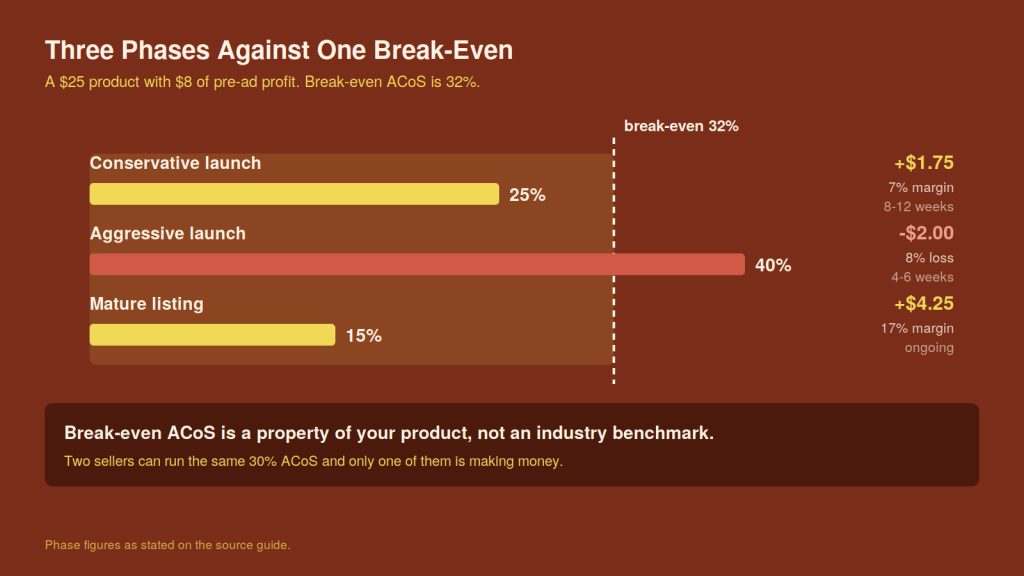
One break-even, three deliberate positions against it. Only one of them is meant to lose money.
The aggressive row is a deliberate loss with a stated duration, which is the only form in which it is defensible. Four to six weeks of negative contribution to establish rank is a budget. The same campaign at month four is not a strategy, it is an unexamined setting.
What to Watch, and When to Stop
Three checks, on a weekly cadence.
Keyword ranking. Track organic and sponsored position for your top 10 to 15 target terms. Rising organic position on terms you are advertising is the evidence that the launch spend is doing what it is for.
Organic share. Aim for roughly 50% of sales coming from organic by month three. Above 70% dependence on ads is the threshold where the listing is not standing on its own.
Campaign profitability. A campaign that exceeds break-even ACoS for two consecutive weeks should be paused or restructured. Two weeks is long enough to rule out noise and short enough to limit the damage.
One modeling discipline worth adopting alongside those: when you project organic lift from advertising, use a factor of 0.3 to 0.5 of ad sales volume rather than a number that makes the plan work. A hundred ad sales a week at launch might reasonably produce fifty additional organic sales a week by week eight. Assuming more is how aggressive launches get extended.
Put the Ads in the Model
The correction here is small and it is not analytical. Add one line to your unit economics called advertising, populate it with CPC divided by conversion rate, and let the margin fall to whatever it falls to.
The number you get will be worse than the one you had, and it will be the first one that describes the business you are actually running. Products that were marginal will show as unprofitable, which is useful, because those are the ones currently being subsidized by the products you thought were merely good.

